
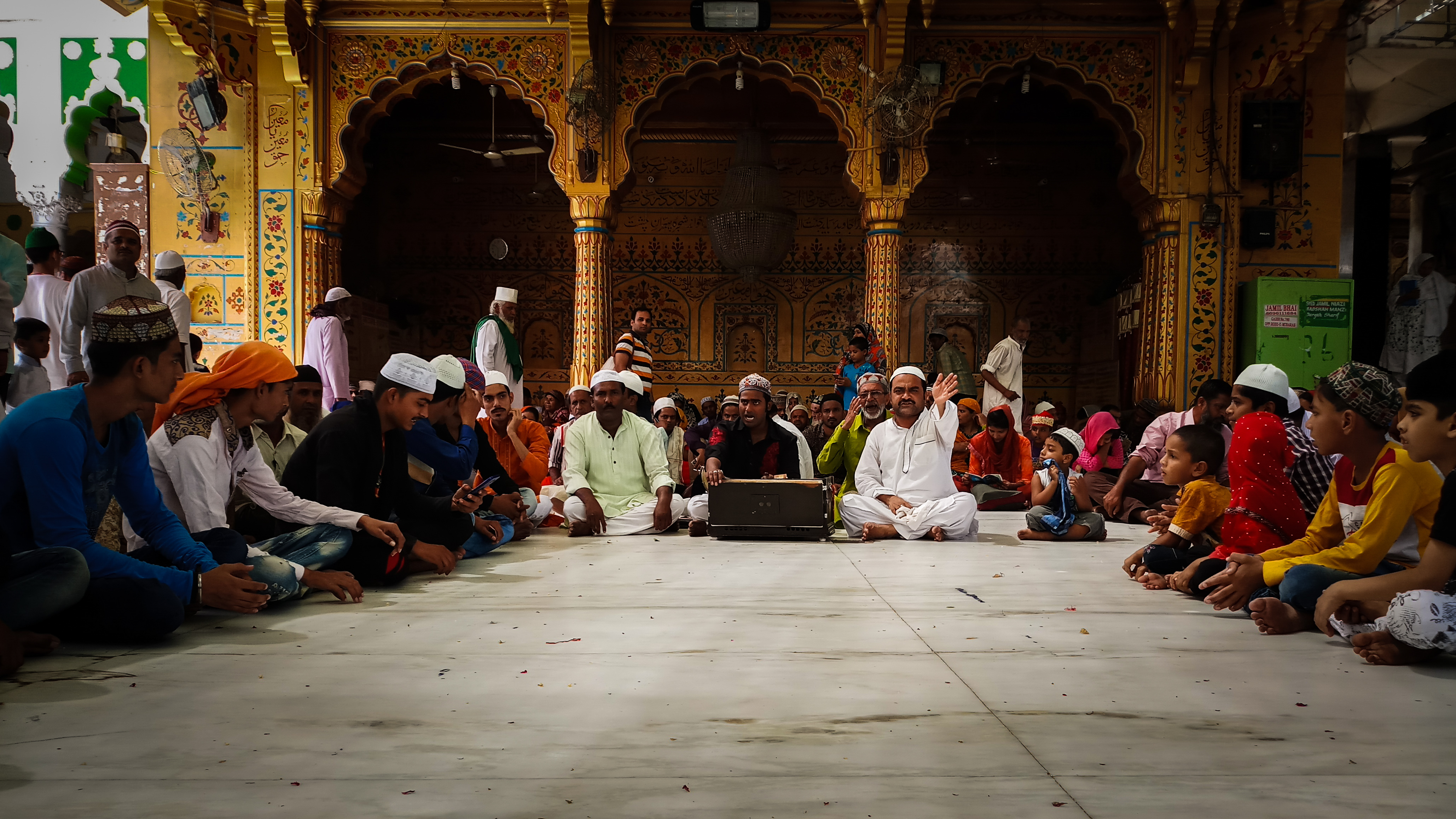
While the devotional songs sung at Hindu shrines are usually created in Sanskrit, Hindi, or other Indian regional languages, the Qawwali mehfils' compositions are usually a selection of inspiring religious poetry in Persian written by several renowned Sufi poets and dervishes. The charm of such Qawwali concerts has proved remarkably persuasive in softening and capturing a human heart containing even the tiniest spark of piety and devotion. They have a hypnotic effect on spiritually inclined audiences, inducing an irrepressible jazba (strong sensation) that leads to wajd (ecstasy).
Since time immemorial, music has played an essential role in India's religious and social life, and singing or recital of devotional songs known as bhajans, for example, has been one of the most significant ceremonials in Hindu temples and religious assemblies. The intriguing mixing of lovely melodies in Sufistic style spreading the message of Truth was invented by the Khawaja Sahib. This medium fitted Indian culture, temperament, customs, and traditions well, resulting in his Sama or Qawwali mehfils (congregations) becoming extremely popular with excellent outcomes, and they remain so till today
On one hand, a flawless Qawwal is a master of traditional Indian music with a pleasant and captivating voice, and on the other, he or she is well-versed in a wide range of selected poetical works on Sufism by illustrious Persian, Urdu, and Hindi poets. A very good Qawwal still requires the "spiritual blessings" of any great Sufi saint for final excellence and wide recognition, in addition to many years of rigorous practice compatible with the various understanding of the stated poetry. There are several examples of exceptional Qawwals who have risen to fame and prosperity in India thanks to the graces of one or more Sufi saints.